Conquering the Agile MVP Development Cycle: My Proven Approach
Liam Hayes – Startup Founder – One of the key elements to our success was mastering the agile MVP development cycle.
Sep 17, 2024 | 7 Minute Read
What is Agile Development?
Agile MVP development cycle is like jazz—improvisation at its best. It’s all about being flexible, working together, and moving fast. Forget the rigid plans; Agile teams roll with the punches, making sure what they build actually matches what users want and what the market needs. This makes Agile perfect for startups and any business that needs to whip up software without a hitch.
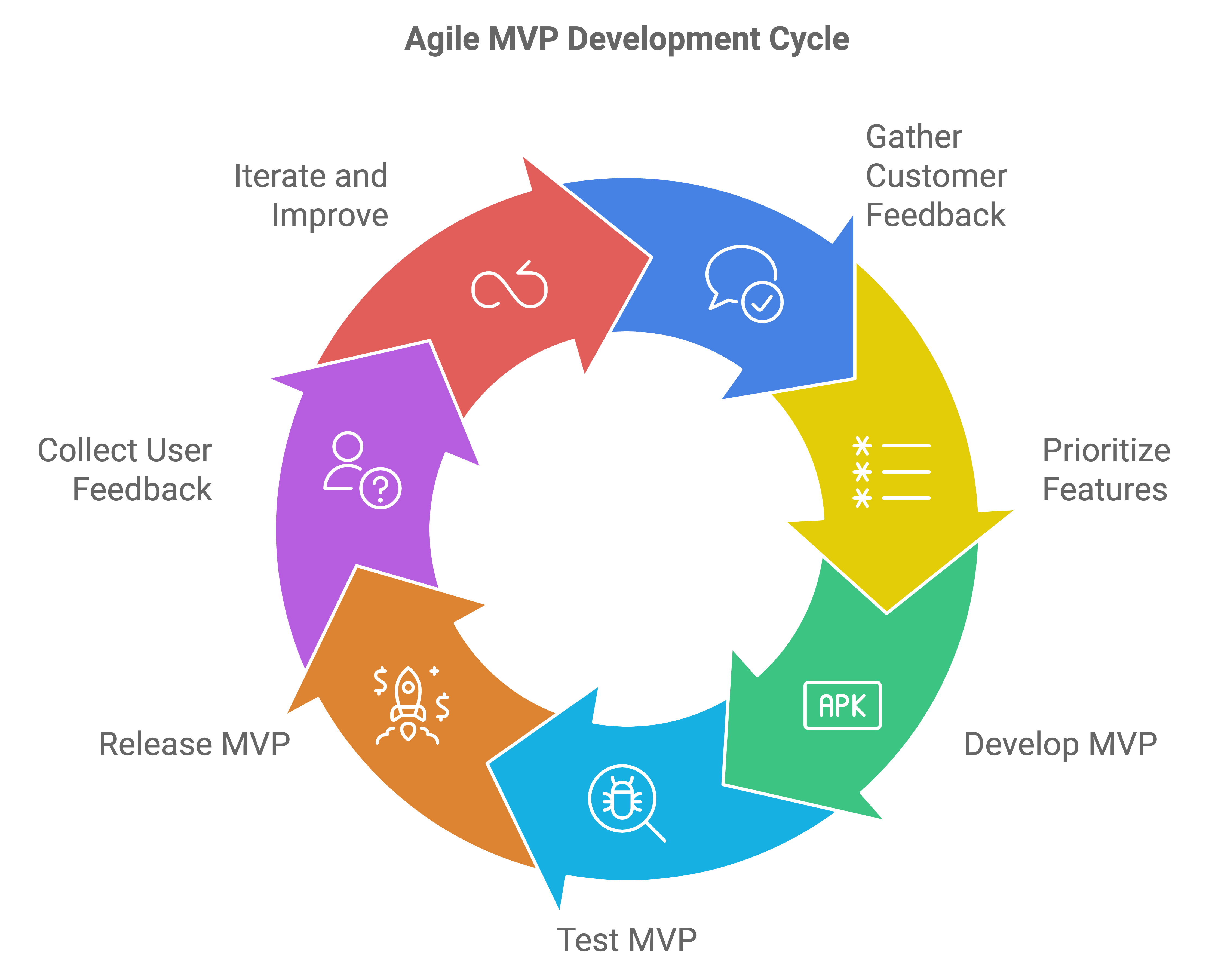
A big deal in Agile is getting customer feedback at every step. Users help steer the ship, deciding what’s important and what’s not. By chatting with customers early and often, Agile teams can hit the nail on the head with products that users really need.
Here’s a quick peek at the Agile stages:
| Stage | What Happens Here |
|---|---|
| Ideation | Coming up with ideas and nailing down the project’s goals and requirements. |
| Development | Writing the code and building stuff, usually in short bursts called sprints. |
| Testing | Checking the software for bugs and making sure it works as expected. |
| Deployment | Rolling out the software to users bit by bit to get their feedback. |
| Operations | Keeping the software running smoothly and updating it based on what users say. |
In Agile development cycle, retrospectives are key. It’s like a team pow-wow to look back at what worked, what didn’t, and how to do better next time. This keeps things running like a well-oiled machine, allowing teams to handle any hiccups along the way.
What is an MVP?
An MVP is the bare-bones version of your product that still solves your users’ main problem. Think of it as the simplest thing you can build to start getting real-world feedback. The idea is to get something out there fast, see what users think, and then make it better from there.
Creating an MVP is like dipping your toes in the water. You don’t need to build the entire product with all the bells and whistles right away. Instead, you put together something basic but functional, test it out, and adjust based on what you learn. This is gold for startups and smaller businesses that need to save time and money while checking out new market opportunities.
The MVP creation steps are pretty much the same as the Agile stages but zoomed in on just the must-have features:
| Step | What Happens Here |
|---|---|
| Ideation | Pin down the problem, who you’re targeting, and what the MVP needs to do. |
| Development | Build the MVP, only focusing on the essentials. |
| Testing | Test the MVP like crazy to make sure it works and isn’t buggy. |
| Deployment | Roll out the MVP to a select group of users or early adopters. |
| Feedback Gathering | Gather and analyze user feedback to decide the next steps. |
Starting with an MVP helps you figure out if there’s a good product-market fit before you dive in headfirst. This way you avoid wasting time and resources on features nobody needs.
Now you’ve got the lowdown on Agile and MVPs. Time to get out there, start building, and turn those ideas into something real. Happy coding!

Get Into Agile MVP Development 🚀
What is the Buzz About Agile?
Diving into an Agile MVP development cycle isn’t as scary as it sounds. Let’s break it down: Agile means breaking your project into bite-sized chunks, which you knock out in “sprints” – just a couple of weeks at a time. Here’s how it generally shakes out:
- Idea Time: Which problems are you gonna solve? What does the MVP absolutely need?
- Build Time: Design it, code it. This bit can take a while.
- Test Drive: Does it work? Time to find bugs.
- Launch Party: Users get their hands on it.
- Help & Fixes: Keep it running smooth, iron out the kinks.
Agile is all about getting stuff done fast and tweaking on the fly. Every sprint, you regroup, chat, and plan out the next steps.
| Phase | What You Do |
|---|---|
| Idea Time | Spot the opportunity, pin down what users need |
| Build Time | Design, architect, and code |
| Test Drive | Quality checks, squash bugs |
| Launch Party | Go live, users get to play |
| Help & Fixes | Support and updates, keep improving |
Steps to Make Your MVP 🎯
So, you wanna build an MVP? Alright, here’s the game plan:
Plan It Out
First off, nail down what problem your MVP tackles and make sure everyone’s on the same page. Identify core features that solve users’ main headaches.
- Figure out what users need.
- Sketch out main functions.
- Set benchmarks for success.
Baby Steps
Roll out a simple version of your MVP. Sketch it, mock it up, make a wireframe.
- Create wireframes.
- Develop user stories.
- Plan out your sprints.
Build & Improve
Now it’s time to roll up the sleeves and start coding. Keep tweaking and testing continuously.
- Design the user experience.
- Code like there’s no tomorrow.
- Test constantly and integrate feedback.
Let It Fly
Once you’ve got a working prototype, let a few users try it. Gather real-world feedback.
- Deploy your MVP.
- Watch and learn from how users react.
- Adjust based on feedback.
Keep It Going
Post-launch, keep the momentum. Fix issues, and keep updating.
- Offer solid support.
- Roll out regular updates.
- Monitor key indicators.
Time to Move On
End of the road? Plan a shutdown and transition users smoothly.
- Phase out older versions.
- Move users to the next big thing.
- Use insights to shape future projects.
Follow these steps, and you’re on track for a smooth MVP launch. Curious about specific cases? Check out more such articles on our site (links below).
| Stage | What It’s Like |
|---|---|
| Plan It Out | Nail down user needs and ‘must-have’ features |
| Baby Steps | Simple prototypes, wireframes, and sprint planning |
| Build & Improve | UX/UI design, coding, continuous testing and tweaking |
| Let It Fly | Launch to a select group, get feedback |
| Keep It Going | Provide support, push updates, track performance |
| Time to Move On | Plan for end-of-life, transition users, analyze for next steps |
Keen to learn more? Explore our resources on specialized MVP strategies and techniques to get deeper insights and take your MVP game to the next level:
- MVP KPIs for Optimal Results
- Transitioning from MVP to Full Product
- Accelerate Time to Develop an MVP
Useful Resources:
How to set up a Minimum Viable Product (MVP)
FAQs
What is MVP in Agile development?
Answer: In Agile development, an MVP (Minimum Viable Product) refers to the simplest version of a product that can be released to gather maximum validated learnings about customers with the least effort. This concept is crucial in Agile methodologies because it emphasizes iterative development, early testing, and feedback incorporation. Learn more about our MVP KPIs for Optimal Results.
What is the MVP development cycle?
Answer: The MVP development cycle involves several key stages: ideation, prototyping, testing, and feedback. This cycle is designed to quickly produce a product version with enough features to satisfy early adopters and provide insights for future development iterations. The cycle repeats with improvements at each iteration based on user feedback and data.
What is the MVP of the Agile principles?
Answer: The MVP of Agile principles centers on delivering a functional yet minimal product that provides value while minimizing waste during the production process. This approach aligns with Agile principles such as customer collaboration, responding to change, and continual improvement. Explore how Transitioning from MVP to Full Product.
What is the MVP process?
Answer: The MVP process entails planning, building, launching, and learning. Initially, a basic version of the product is planned and developed quickly to meet the core needs. It’s then launched to target users to gather critical feedback and insights, which guide further development. This process helps validate assumptions, reduce development costs, and improve the product effectively.