Hidden Costs of Hiring Offshore Developers (What Agencies Don’t Tell You)
Hidden Costs of Hiring Offshore Developers (What Agencies Don’t Tell You)
The pitch sounds simple: developers at $25 per hour instead of $150. Hire offshore, save 80%, launch faster.
Sometimes that is exactly how it goes. But many founders end up spending far more than the quote — and they only find out where the money went after it is gone.
We are an offshore development company in India. That gives us a strange advantage for writing this post: we know every one of these hidden costs from the inside, including the ones our own industry prefers not to discuss. Here are the real hidden costs of hiring offshore developers — and how to avoid each one.
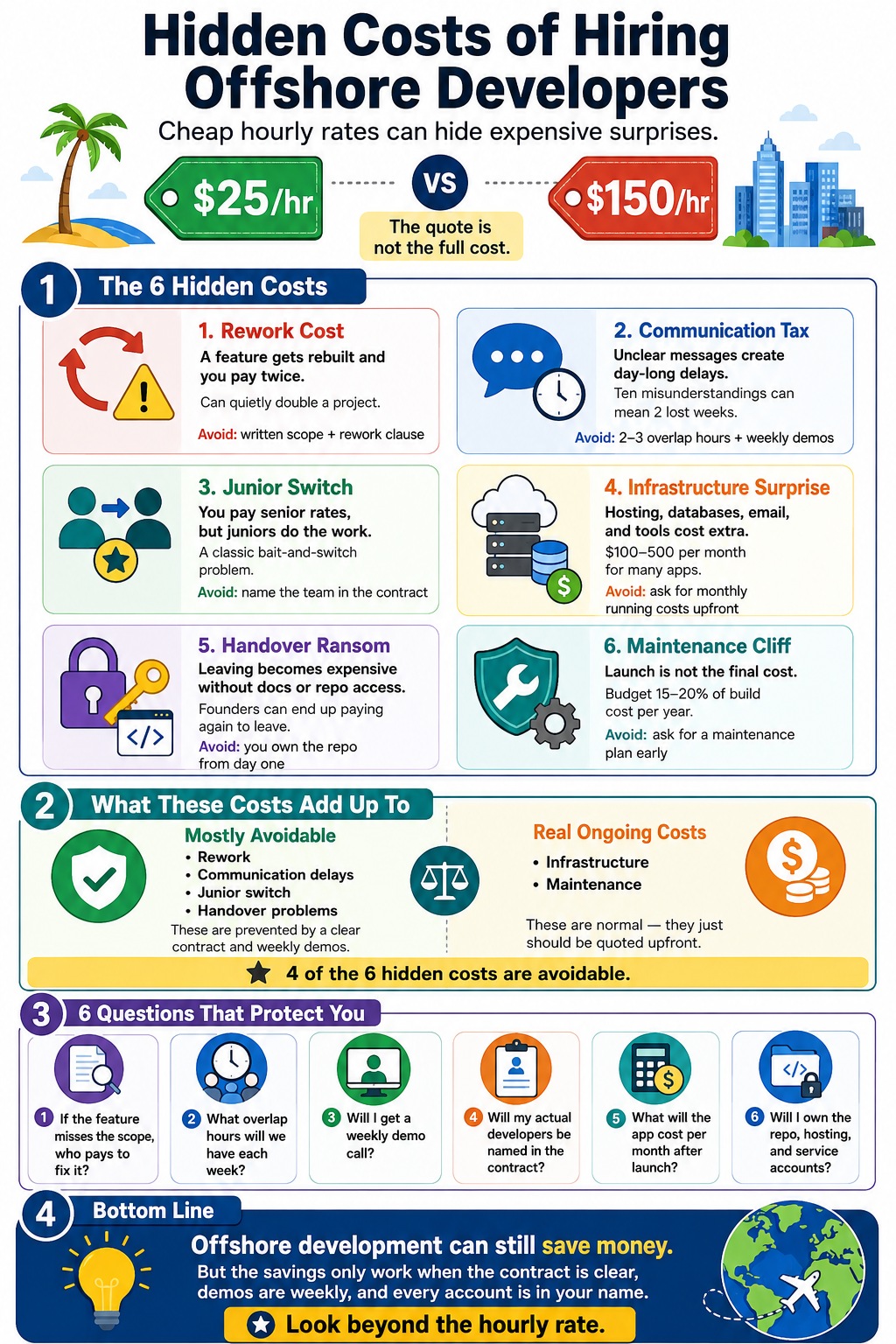
1. The Rework Cost: Paying Twice for the Same Feature
This is the biggest one. A feature gets built, it does not match what you meant, and it gets rebuilt — on your bill. With vague requirements, rework can quietly double a project.
Why it happens: Cheap quotes win contracts. Cheap quotes assume everything is understood perfectly on the first try. Nothing ever is.
How to avoid it: Before work starts, ask for a written scope with screens and examples — not just a feature list. Then ask the question that reveals everything: “If a finished feature does not match the scope, who pays for the fix?” A serious agency has a clear answer.
2. The Communication Tax
Every unclear message costs a day. You write a request at 9 AM your time, the team reads it while you sleep, and if anything was unclear, you lose a full cycle. Ten misunderstandings means two lost weeks — and if you are paying monthly, lost weeks are a real cost.
How to avoid it: Insist on two things: a fixed overlap window (2–3 hours where both sides are awake and reachable) and a weekly demo call where you see working software, not a written status report. If an agency resists either, that is your answer.
3. The Junior Switch
You interview an impressive senior developer. The contract gets signed. Three weeks in, the work quality drops — because the senior moved to the next sales cycle and juniors are doing your build. The rate stayed senior; the output did not. It is common enough across the industry to have a name: bait-and-switch staffing.
How to avoid it: Get the names of the people who will actually write your code into the contract, along with a clause that replacements need your approval. Then join a call with the actual team in week one and week three. Voices do not lie about who is doing the work.
4. The Infrastructure Surprise
The development quote rarely includes what the app runs on: hosting, databases, third-party services, app store accounts, email delivery, monitoring. Individually small, together $100–500 per month for a typical app — forever. Some agencies also register these accounts under their own names, which becomes a problem the day you part ways.
How to avoid it: Ask for a monthly running-cost estimate alongside the build quote. And put every account — hosting, domains, stores, databases — in your name from day one, with the agency added as a collaborator. Ownership is free on day one and expensive to recover later.
5. The Handover Ransom
The project ends, or you want a second opinion, and suddenly the code is hard to get: no documentation, no deployment instructions, unclear repository access. Some founders effectively pay a second time just to leave. Even without bad intent, an undocumented codebase costs weeks for any new developer to understand.
How to avoid it: Your contract should state, from day one: the code lives in a repository you own, it is pushed there at least weekly, and documentation plus deployment steps are part of the deliverables — not an extra. If you sign nothing else from this post, sign that.
6. The Maintenance Cliff
The launch price is not the price. Real apps need updates — operating system changes, security patches, small fixes. The industry rule of thumb is 15–20% of the build cost per year. Agencies rarely mention it because it makes the launch quote look bigger.
How to avoid it: Ask for the maintenance plan and its monthly price before you start, and budget for it. An honest agency will tell you; a sales-driven one will say “we can discuss that later.”
What the Hidden Costs Add Up To
| Hidden cost | Typical impact | Avoidable? |
|---|---|---|
| Rework from vague scope | Up to 2x the quote | Yes — written scope + rework clause |
| Communication delays | Weeks of paid time | Yes — overlap hours + weekly demos |
| Junior switch | Senior rates, junior output | Yes — named team in contract |
| Infrastructure | From $100/month ongoing | No — but should be quoted upfront |
| Handover problems | Weeks + repeat payment | Yes — you own the repo from day one |
| Maintenance | From 15% of build cost/year | No — but should be quoted upfront |
Notice the pattern in the right column. Four of the six disappear with a proper contract and process. The other two are real costs of running any app — the only “hidden” part is agencies not quoting them upfront.
The Questions That Protect You
Put these six questions in your first call with any offshore agency. The answers tell you more than any portfolio:
- If a finished feature does not match the written scope, who pays for the fix?
- What are the overlap hours with my time zone, and will I get a weekly demo call?
- Will the names of my actual developers be in the contract?
- What will the app cost per month to run after launch?
- Is the code pushed weekly to a repository I own, with documentation included?
- What does maintenance cost per month after launch?
These pair with the vetting checklist in our guide on how to hire developers to fix an AI-generated app — the same rules protect you whether the project is a rescue or a new build.
Common Questions
Is hiring offshore developers still cheaper after all the hidden costs?
Usually yes, by a wide margin — if you avoid the avoidable costs. A well-run offshore project with rates from $20 per hour beats US agency prices even with maintenance and infrastructure included. A badly run one can cost more than hiring locally.
What is the biggest hidden cost of offshore development?
Rework. Features rebuilt because the requirements were unclear can double a project’s cost. A written scope with screens and examples prevents most of it.
How do I make sure I own my code?
Three things in the contract: the repository is under your account, code is pushed to it at least weekly, and all hosting and service accounts are registered in your name. Set this up on day one.
How much should I budget for maintenance?
Plan for 15–20% of the build cost per year. An app built for $10,000 needs roughly $1,500–2,000 per year to stay healthy.
The Bottom Line
Offshore development is not a trap — we would not be writing this if it were. The savings are real. But the industry sells the hourly rate and stays quiet about everything around it. Now you know what the quiet parts cost, and that every one of the avoidable ones is prevented by the same thing: a clear contract and a weekly demo. Choose an agency comfortable with both, and the math works the way the pitch promised.
Want a quote with nothing hidden? McLanSys builds and rescues apps for founders across the USA, Canada, Singapore, and Australia — with your name on every account, weekly demos, and running costs quoted upfront. Start with a free consultation, and if you move forward, your first 100 development hours are on us.
↓ Fill Out the Form Below for a Free Consultation