How to Track MVP Progress to Scale Your Startup Effectively
Liam Hayes – Startup Founder – In this post, I’ll share insights on how to track MVP progress effectively to ensure your startup is on the right path.
May 30, 2025 | 5 Minute Read
Keeping Tabs on Your MVP’s Progress
Keeping an eye on your Minimum Viable Product (MVP) isn’t just important—it’s everything. It’s the secret sauce for spotting hiccups, boosting performance, and making smart moves. Let’s break down why hitting milestones and checking key stats matters for your MVP’s progress.

Why Milestones Matter
Milestones are like those “You Are Here” signs at the mall. In MVP land, they’re checkpoints that show you’re hitting targets on your roadmap. They also make it easier for your team to stay on track. In Scaled Agile Framework (SAFe), you see these through the rhythms of Iterations and Program Increments (PIs) rather than old-school phase gates.
Types of Milestones
- PI Milestones: Check these at the end of each program increment to see if you’re smashing those goals.
- Fixed-date Milestones: These are locked to the calendar, helping you know if you’re running on schedule.
- Learning Milestones: Validate your assumptions and learn from every experiment, keeping that innovation engine running.
These different milestones give you a 360-view of your MVP’s health. By keeping track, you can see if you’re creating real value, spot risks, and make changes on the fly.
Making the Most of Key Performance Indicators (KPIs)
KPIs are your yardstick for success, plain and simple. They’re specific, measurable, and tied directly to what you care about. Here’s how to make KPIs work for you:
- Define Success: What does winning look like for your MVP?
- Pick the Right KPIs: Match them to your goals. If you’re a SaaS product, user engagement, retention, or revenue might be your magic numbers.
- Keep Everyone in the Loop: Make sure the team gets what these KPIs mean. Communication is key.
- Lean on Tools: Gantt charts, burn-down charts, Kanban boards—use whatever helps you see where you’re at.
| KPI Type | What It Measures | Example Metrics |
|---|---|---|
| User Engagement | How much users love your product | Daily Active Users (DAU), Session Length |
| Retention Rates | Who’s sticking around | 30-day Retention Rate, Churn Rate |
| Revenue Growth | Money talk | Monthly Recurring Revenue (MRR), Customer Lifetime Value (CLTV) |
| Market Fit | Are you hitting the mark? | Net Promoter Score (NPS), Customer Feedback |
By tracking these KPIs, you get real-time insights into how your MVP is doing. This means you can make smarter choices and tweak things as needed.
For more strategies on using KPIs to keep tabs on your MVP, check out our MVP KPIs for Optimal Results. Want to learn about measuring MVP success? Check out Transitioning from MVP to Full Product
Keeping your MVP on course ensures it hits its targets and adds value to your users. By effectively using milestones and KPIs, you can steer your startup towards growth and success.
Keep Tabs on Your MVP Like a Pro
Tracking your Minimum Viable Product (MVP) progress is a game-changer for growth and success. Get a grip on these strategies, and you can keep your startup on solid ground, ready for whatever comes your way. Here’s how to nail effective MVP tracking.
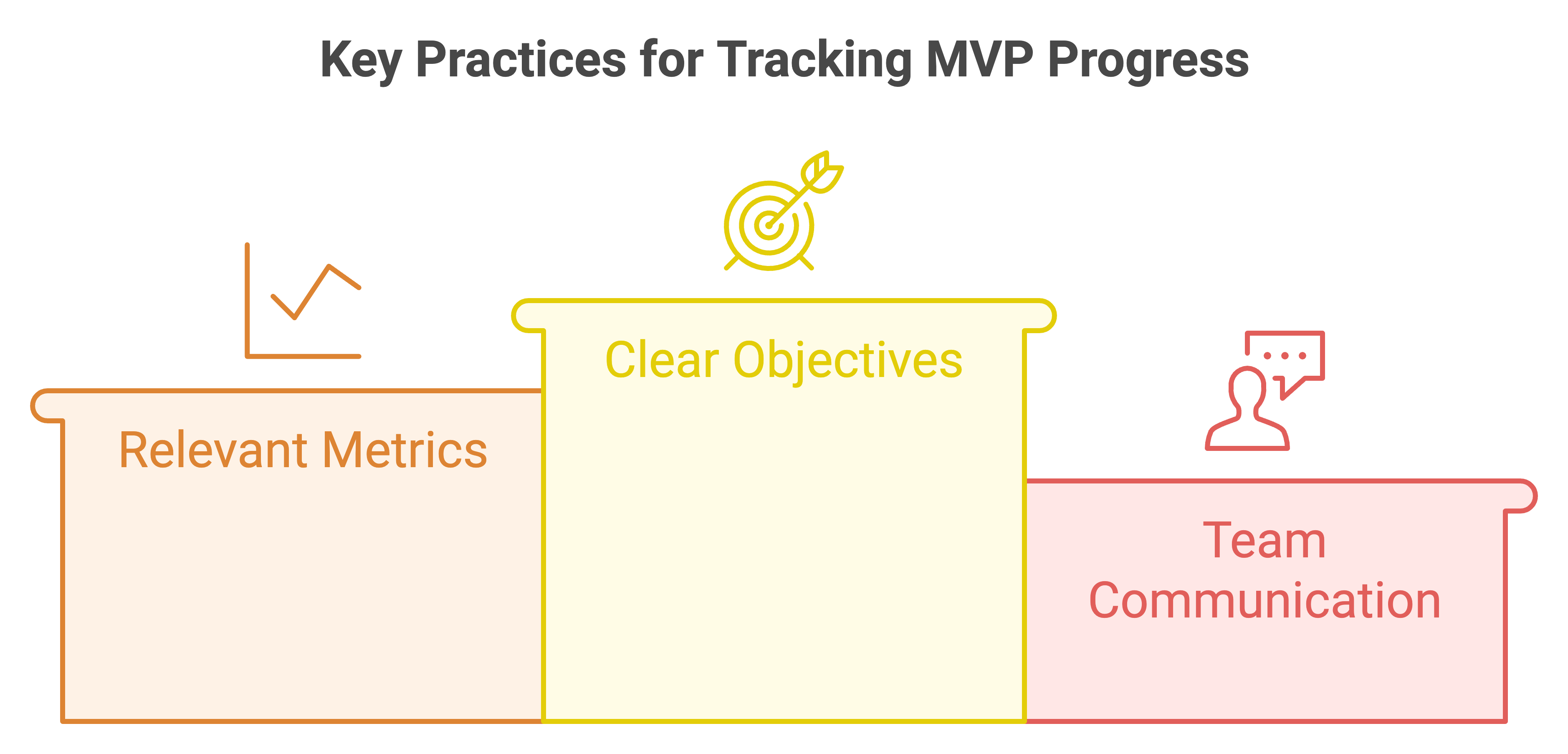
Set Clear Goals—No Fuzzy Stuff
Before you start, you need clear and specific goals. These are your north star, guiding your every move with your MVP. Make sure your goals are SMART—specific, measurable, achievable, relevant, time-bound.
How to Draft Those Goals:
- Find Your Why: What problem does your MVP solve?
- Current Snapshot: Where are you standing right now?
- Outcome Check: What have your first steps shown you?
- Spot the Hiccups: What could trip you up?
- Measure Success: What numbers show progress (KPIs)?
- Keep an Eye on KPIs: Regularly check these numbers.
Regular Goals for MVPs
| Goal | What’s It About? |
|---|---|
| User Engagement | How often are folks using your stuff? |
| Customer Acquisition Cost (CAC) | What’s it cost to snag a new customer? |
| Monthly Recurring Revenue (MRR) | Regular monthly cash flow. |
| Churn Rate | Who’s bailing and how often? |
| Customer Lifetime Value (CLV) | Total moolah you can make from one customer over time. |
Setting and reviewing these goals will give you a solid grip on where you’re headed and what needs tweaking for growth.

Use Cool Tech for Data Crunching
Tech can turbo-charge how you track and measure your MVP’s progress. These tools can dish out insights to steer your decisions and plans.
Tech Tools at Your Fingertips:
- Data Analytics Platforms: Google Analytics, Mixpanel, Amplitude for tracking user actions.
- Business Intelligence Software: Tableau, Power BI for clear views of complex data.
- CRM Systems: Salesforce, HubSpot for managing customer ties and metrics.
- CI/CD Practices: Automate testing and deployments with CI/CD to speed up market entries.
- Agile Frameworks: Scrum or Kanban for iterative development and feedback loops.
Using these tools, you can gather, slice, and dice data to keep tabs on your MVP and make smart, data-driven choices.
Data Metrics You Should Watch
| Metric | What’s the Deal? | Tool |
|---|---|---|
| User Engagement | Tracks feature usage. | Google Analytics |
| CAC | Cost to nab a new customer. | Salesforce CRM |
| MRR | Regular monthly cash flow. | Tableau |
| Churn Rate | User dropout rate. | Mixpanel |
| CLV | Expected cash from one customer. | HubSpot CRM |
Grasping how to keep tabs on your MVP with clear goals and snazzy tech is crucial for your startup’s success. By putting these strategies into action, you can sharpen and tweak your MVP based on real-time nuggets, steering your startup to the stars.
Useful Resources: